

Is your child with Down Syndrome struggling with addition and subtraction? If so, try focusing on the essential math skills needed before beginning addition. Here are ten hands-on ways to develop number sense and prepare your child for addition and subtraction.
1. Count to ten by rote.
This is so basic, but being able to count to ten accurately by rote is foundational to all other math skills. So, count everything with your child.
- Count the steps with your child as you go up and down the stairs
- Count out blueberries, strawberries, and any type of snack as you put them on a plate.
- Count how many steps it takes to get from the door to the car.
- Count how many plates, forks, and spoons as you set the table.
- Count how many seconds to brush hair and wash hands.
- At a red light, count how many seconds before the light turns green
- Sing songs such as “One, Two, Buckle my shoe” and other counting songs.
2. Identify numbers 1-10.
To help your child identify the numbers 1-10 try these activities:
Help your child match, select, and name numbers. Matching is a powerful learning tool for children who are visual learners. Print out two sets of 1-10 number cards. Line up numbers 1-4 on a table. Next, place another set of numbers 1-4 below in random order. Name each number as you help your child match the numerals.

Once your child can easily match numerals 1-4, ask him/her to select (point to or give you) the number you ask for. You can say, “Can you give me the number 2?”.
Once your child has given you all the number cards, you can then use them as flash cards, and simply ask, “What number is this?”
Play with foam or crepe number puzzles. I prefer these to wooden number puzzles because the child has to press the pieces in, which is good for fine motor skills. Pop all the numbers out, and help your child find where to fit each number in. This is also matching exercise that helps him visually discriminate where each number should fit. As he presses a number in, have him say the number over and over. Playing with this puzzle is how my son learned to identify numerals.

Practice tracing and writing numbers
Repeatedly tracing and writing numbers helps to engrain them in the mind. When your child is first learning to trace a number, you can help with very gentle hand-over-hand guidance. Or, your child’s marker can follow yours. Don’t worry about neatness for now; just work on getting the strokes in the right order and direction.
Here are some free worksheets to help your child learn to write numbers:

3. Order numbers by size
Ordering numbers by size helps give concrete meaning to numerals.
My favorite manipulative for this are wooden bars:

There are many ways to use this Montessori-inspired math set. But we have used it mostly for ordering numbers by size. I give my son one set of 1-10 bars in random order, and have him put them in order from smallest to largest or vice versa. You can do this with the number side up or down.


This activity can also be done with laminated strips of paper.
4. Order Numerals from 1-10
Many children with DS will need *a lot* of practicing putting numerals in order, even if they can count by rote.
One way we practiced ordering numerals was with sequence puzzles.


Print on card stock, laminate, and cut on the dotted lines. Give your child a number line to help remind him/her which order to place the numbers. (This set comes with matching number lines) When your child puts the numbers in order, he/she will be rewarded with a picture.
You can get a free set of Woodland Animals sequence puzzles here.
5. Count Items with a Single Row Ten-Frame
Most ten-frames are double row. But a single row ten-frame is much better at helping students develop number sense. I prefer a single-row ten frame because:
- it prepares students to subsitize (identify a a quantity without counting) on a rekenrek
- it helps children to understand tens and ones
- you can use a number line with it
- it also allows children to see how numbers relate to five and ten. For example, 7 is 5 and 2; 8 is 5 and 3, and 9 is just one less than 10
I made this ten-frame by gluing wooden rings onto a wooden strip.

You can buy more elegant ones like this at Etsy:
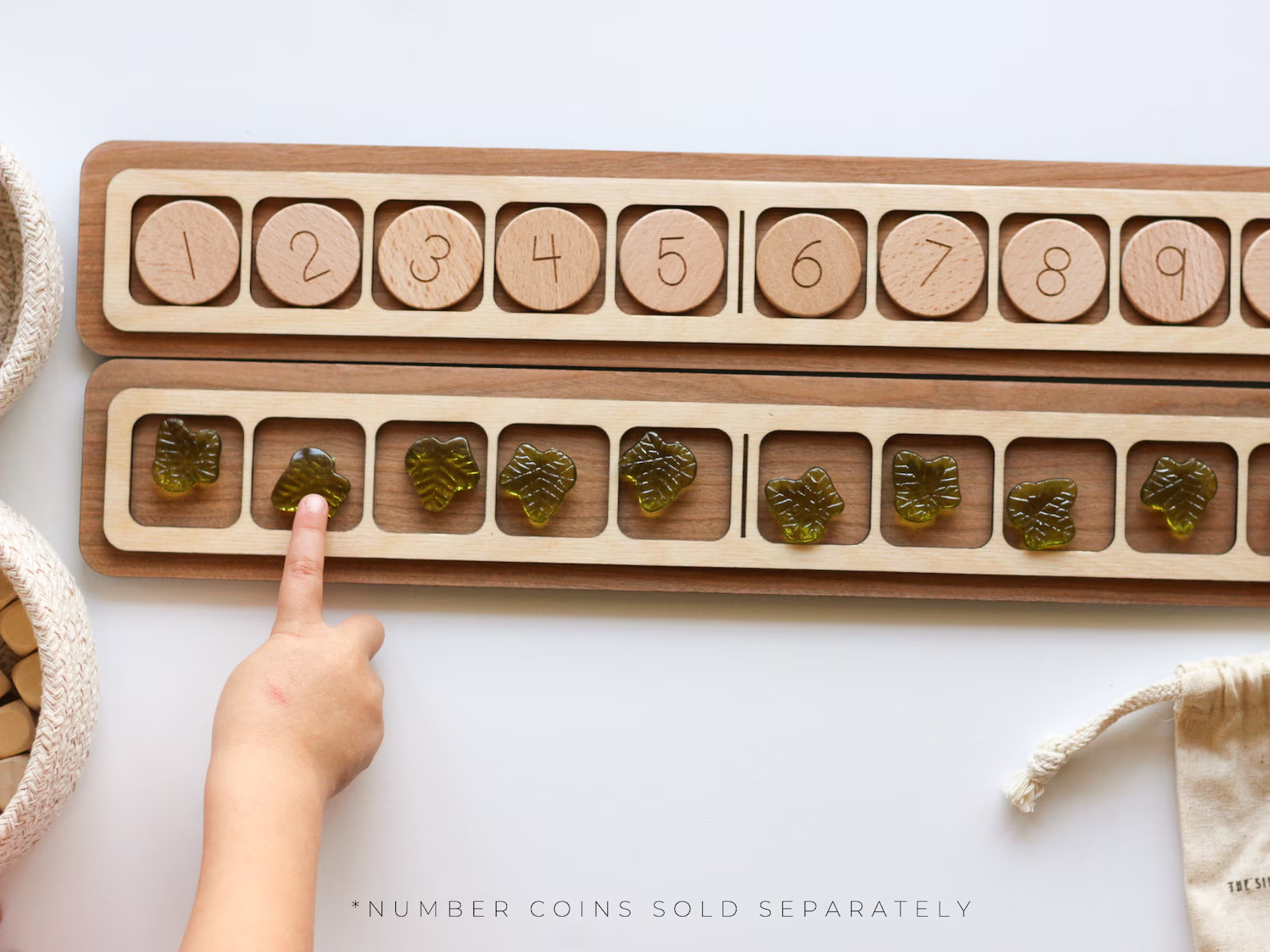
Give your student some small items such as buttons, pebbles, or acorns. Help him count them as he places one in each hole/well. This develops one-to-one correspondence. The more he does this, the more he will see how numbers relate to five and ten. For example, your child will see that six is five and one more. Seven is five and two more. Nine is one less than ten. And so on.
Instead of a wooden ten-frame, you can also print this out and cut into two frames.

Print on card stock and laminate. Then you can put cheerios, blueberries, raisins, etc. on it. When your child asks for cheerios, you can ask, “how many?”. Then help him count them out with the number line and place them in the boxes.
An expansion on this activity is developing the important concept of “enough”. For example, You can ask your child how many blueberries he wants. If he asks for six, give him four. Then ask, “Did I give you enough? How many more do you need?” Use the number line and ten-frame to show him that he needs two more.
These activities are much more helpful at developing number sense than simply counting items arranged randomly on a plate. Order is at the very heart of math, and the more orderly you present it, the sooner students will grasp mathematical concepts.
6. Subsitize Numbers on a Rekenrek and Ten Frame
Many children with DS are strong visual learners. Being able to subsitize numbers allows them to work on arithmetic with greater speed and accuracy.
Subsitizing is
looking at a quantity and identifying how much it is without counting.
Most of us can easily subsitize the dots on dice. Think how cumbersome it would be to play Monopoly if the players had to count each dot on the dice every time they rolled.
With practice, many children with DS can learn to subsitize numbers on a rekenrek. A rekenrek is no ordinary abacus. On a rekenrek, beads are color-grouped by fives. Like a single row ten-frame, this allows students to see numbers in relation to five and ten.
This is a 20-bead rekenrek. Use it when your student is first learning to count, and for addition and subtraction within twenty.

This 100-bead rekenrek is great for learning to subsitize, as your child can practice finding all the twos, threes, fours, fives, etc. on the rekenrek. Of course it is also great for addition and subtraction within 100.
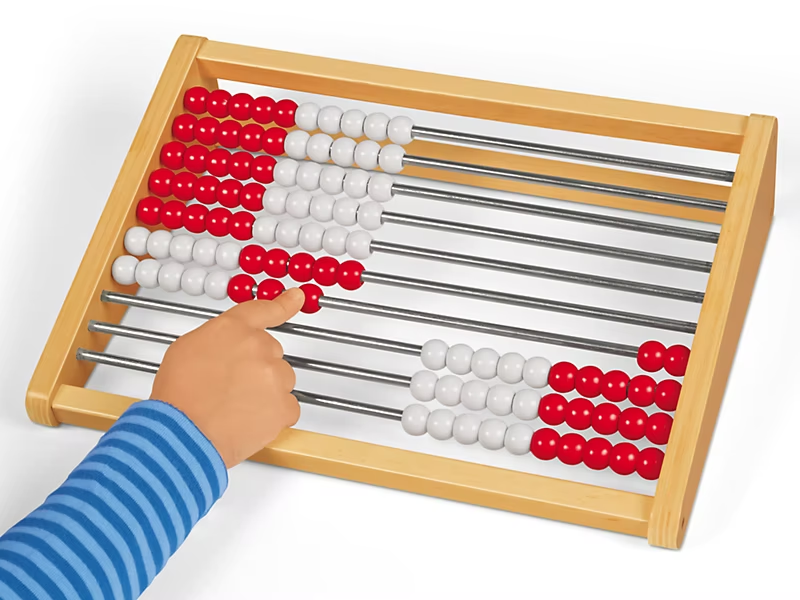
First teach your child to subsitize (or find) all the ones, tens, then fives on the rekenrek without counting. Five is all the red beads or all the white beads in a row. For example:
Four is just one less than five. Teach him to subsitize the fours on each row. Then all the twos and threes.
Once your child can easily find all the above numbers, teach him that six is five and one, seven is five and two, eight is five and three. Lastly, nine is just one bead less than ten.
Next, work on identifying numbers/quantities on the rekenrek:
Then practice sliding quantities on the rekenrek without counting:
Once your child can subsitize on the rekenrek, encourage him to subsitize on the ten-frame. Line up items on the ten-frame (wooden or paper) and help your child name the quantity without counting.
These activities help children develop number sense, which is foundational to all mathematical functions.
7. Name the Missing Number, Name the Next Number

Here is a movable number line my husband and I made for my son out of peg board. My son names the missing number and turns over the card to see if he is right.
You can also use Montessori wooden number cards:

Or a laminated number line with sticky notes:

To make it more fun, take turns hiding the numbers and naming the missing numbers.
Once your child is really good at naming the missing number, play “Name the next number.” Make a stack of flash cards with numbers 1-9 on them (or use the Montessori wooden number cards). Take turns drawing a card and naming the next number. If your student has difficulty, he can check on a number line. The idea is to say the next number as quickly as possible. This prepares for +1 addition facts.

8. Tally and Count on from Five
Tallying and subsitizing tallied numbers is another way of reinforcing how numbers relate to five and ten. It’s also another way to build number sense.
First, build tally numbers with popsicle sticks: place a number card on a piece of paper and use popsicles sticks to build that number by tallying:


As with all new concepts, demonstrate first and then invite your child to build numbers. You can take turns picking numbers and then building them together.
Second, practice counting on. Once your child is adept at building numbers by tallying, build a number with popsicle sticks and show him how to figure it out by counting (if the number is less than five) or by counting on from five (if the number is greater than five.) Place three number cards below and let him choose the correct answer.
For this example, your student simply counts the sticks and chooses the correct number

For this second example , point to the group of 5 sticks and say “5….” Next, help your student count the rest of the sticks by counting on and saying, “6,7,8,9.” Then your student chooses the correct number, nine.

Third, learn to subsitize tallied numbers. Keep practicing until your child can look at a quantity and match a number card to it without counting. For example:
9. Count on from a number other than 1
Being able to count on from a number other than one prepares students to add by counting on from the greater number.
Begin with the help of a number line. Choose a number to practice counting on from and cover all the subsequent numbers with a strip of paper. Model counting on to ten and then check by removing the strip of paper.
In the example below, you would say “Four…. five, six, seven, eight, nine, ten.” If your child gets stuck, let him “peek” at the next number and then try.


You can also use wooden number cards and turn over each face-down card as you count on:


For a child who loves action, you can make a large number line on the floor, throw a bean bag onto a number and count on from that.
With enough practice, your child will be able to count on without a number line :
10. Identify which number is more
This is a skill which often requires lots of practice for children with DS, but once they can do this, you know they are really developing number sense. To help your child with this skill, begin with concrete items.
Start by helping him/her compare quantities on two ten-frames:

Here’s a favorite activity at our co-op: The boys choose two jars and line up the contents on the twenty-frame. Then they can compare which row has more.

Then compare quantities on both rows of a 20-bead rekenrek:

Ask, “Which row has more?” Then, “how much more?“
Compare quantities on two-ten frames with number-lines:

Compare quantities just with a number-line.

For example, take out a 6 card and a 3 card. Ask, “Which is more? 6 or 3?” Help your child find both numbers on the number line and then determine which is more. The further to the right, the greater the number.
Finally, compare two numbers on number cards
You can play a game such as “War”, where each person draw a card. The person who has the greater number gets both cards. Whoever has the most cards at the end wins.
Let’s Review!
Ten essential math skills for developing number sense and preparing children with (or without) Down Syndrome for arithmetic are:
- Count to ten by rote
- Identify numbers 1-10: match numbers, foam puzzle, tracing and writing numbers
- Order numbers 1-10 by size
- Order numerals from 1-10
- Count items with a single-row ten frame
- Subsitize numbers on a rekenrek and ten frame
- Name the missing number; name the next number
- Tally and count on from five
- Count on from a number other than one
- Identify which number is more
A Printable Guide to Ten Essential Math Skills:
For your convenience, here’s a FREE PDF of all these activities, including printable number cards and number lines and checklists:
Once your child is with confident with these skills, he/she is ready to move on to addition.
For a FREE addition workbook written for children with Down Syndrome, check out my post: Simply Addition, Level 1: Learning to Add with a Rekenrek.
You may also be interested in:
HI there, Is there a way to print out your articles? They are amazing. I am a teacher (24 years experience) and I am teaching a super 8 year old kiddo with Down Syndrome who is developmentally working on (more like) pre-k skills and I have been trying to find any resources possible for our kiddo and for our wonderful EAs who support him daily. It is not easy and I want to make sure his days are meaningful and worthwhile and truly include him in learning that will show progress in his world. I am a pencil paper hard copy kind of gal and would love these articles in my hand to refer to when I am in class. Thank you for any suggestions.
Hello! I love that you are trying to find work that is meaningful and worthwhile for your student with Down Syndrome! I will prepare a PDF of this article and add it to this post. If there are others you would like in PDf format, let me know and I’ll see what I can do.