

Today I’m sharing my favorite math manipulative for kids with (or without) Down Syndrome in Grades K-2. Math can be a challenging subject for many children. But the use of select manipulatives can help them grasp mathematical concepts. They also add fun and variety to math lessons, giving students a break from workbooks.
Note: This post uses Amazon Affiliate links, which means I earn a small commission for anything you purchase through this post at no extra cost to you. Thank you for supporting this blog!
1. The Rekenrek
If you’ve been following this blog, then you already know that my no. 1 math manipulative is the rekenrek. A rekenrek is a simple but ingenious counting rack designed to help students understand numbers in relation to five and ten.
First, students learn to subsitize numbers on the rekenrek (that is, identity quantities without counting, as you would on a die). Because many children with Down Syndrome are strong visual learners, many can learn to subsitize. And once they do, the rekenrek becomes an effective tool for developing number sense and for practicing addition and subtraction.
Furthermore, rekenreks are relatively inexpensive. You don’t need to worry about beads, buttons, and counters spilling on the floor or getting lost.

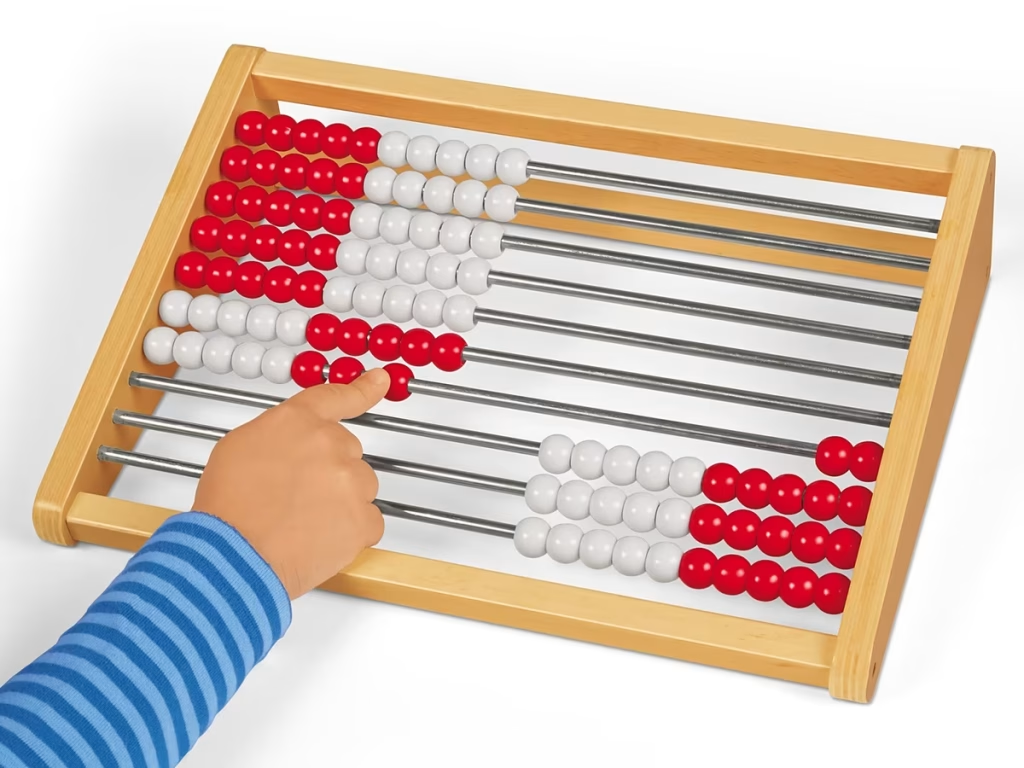
Working with a rekenrek daily has been a game-changer for my son’s understanding of basic mathematical concepts and his ability to solve simple addition and subtraction facts independently.
For a detailed posts on how we use the rekenrek, see :


2. The One-Row Ten Frame
This is the ten-frame used in Kate Snow’s Math With Confidence. It aligns perfectly with the use of a rekenrek, as it enables students to see numbers in their relationships to five and ten.
Use this to teach one-to-one correspondence, counting, and number sense.
The One-row Ten Frame helps students generalize math to real life when you use real-life items such as blueberries and buttons for counting.
In our Down-Syndrome co-op, I use a large laminated ten frame at lunch time. I ask the students how many french fries, grapes, or crackers they want. Then, as I place the items on the ten-frame, the students count them. Usually, I place a lesser number and then ask, “Is that enough? Oh… no? Ooops…. How many more do you need?” With enough practice, the kids are able to tell me how many more they need.
You can make one out of paper, build one with a long piece of wood and wooden rings, or purchase one at Etsy.


For more ideas on using the One-Row Ten Frame, see my post Ten Essential Math Skills that Prepare Children with Down Syndrome for Addition
3. Montessori Place Value Numbers

Once students are counting and building numbers beyond ten, understanding place value becomes very important. Montessori Place Value Numbers are an excellent tool for that. Use a rekenrek and the place value numbers so students can see and understand that 14 is 10 and 4 or 53 is 5 tens and 3 ones, and so on.
For example:
Once students understand place value, a pocket hundreds chart allows students to see numbers in relation to each other.

There are so many activities you can do with a pocket hundreds chart:
- We use it to practice counting by 2s, 5s, 10s, and backwards from ten or twenty.
- I also pull out several numbers, and my son has to find where they belong.
- An extension of that is I pull out random numbers and my son names the missing number.
- We choose random numbers from the pocket chart, build them on two rekenreks, and determine which one is more.
- We practice adding/subtracting one more or ten more.
Skip Counting Puzzles are a motivating way to practice skip counting. They are also a self-correcting activity. When the student puts the numbers in the correct order, a picture is made. If the numbers are not in the right order, the picture doesn’t make sense. My son has really enjoyed them.

I like this as a beginner clock because it shows all the minutes. Students can tell time to the minute without needing to count by fives.

We use this in various ways:
- I choose a time on the clock and my son writes it at the bottom
- I write the digital time at the bottom of the clock, and my son adjusts the hands to make it match the time.
- We look at a real clock, adjust the hands on the beginner clock to make them match the real clock, and then figure out the time.
- We write out our schedule for the day, and he shows all those times on the clock.
7. Play Money
Counting pennies, nickels, and dimes reinforces the concept of numbers in relation to fives and tens. This particular set is organized and has a lid (yes, the extra cost is worth the lid!!!). The coin compartment is curved so it’s easy to pull out individual coins — a bonus for kids who have fine motor challenges.

We use this set to accompany these resources:
Let’s Learn About Money – FREE on this blog
Let’s Go Christmas Shopping – Christmas Shopping Math Activities for Kids with Special Needs
8. Fraction Discs and Fraction Flash cards
The best way to introduce the concept of fractions is in the context of real life: half an apple, half of a sandwich, a third of the pizza, a quarter cup of milk.
From real life examples, we moved to food-themed fraction discs, emphasizing that the food is cut into equal parts.


Eventually we added in wooden fraction disks with flash cards, and magnetic fraction disks and tiles for variety.


For K-2 math, we only focused on identifying and constructing the fractions 1/2, 1/3, 2/3, 1/4, 2/4, 3/4, and the whole numbers 2/2, 3/3, and 4/4.
9. Easy-to-Read Rulers
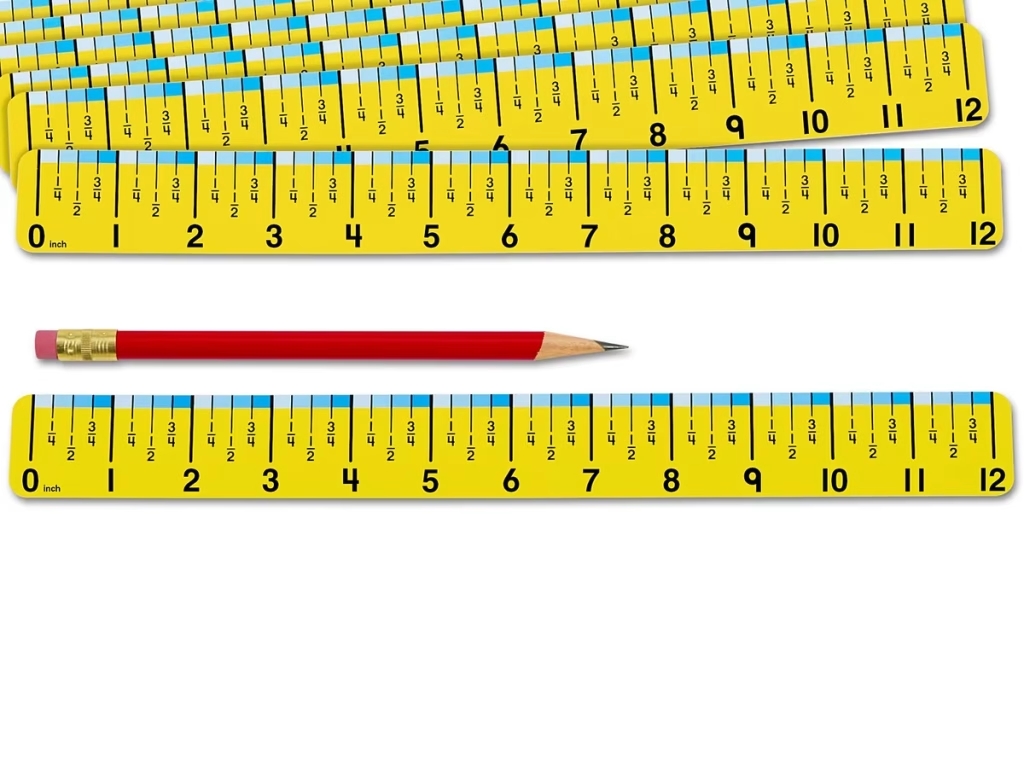
Given the fact that our kids do best with large font, here are my two favorite rulers for helping our students measure things. The Hand-to-Mind Ruler and the Easy to Read Ruler.

Most primary math curricula include work with tangrams, because they help develop many areas of mathematics thinking.

For example, this set helps students:
- See how shapes fit together
- Discover that different configurations of shapes can cover the same area
- Identify and continue geometric patterns
- See how certain pieces can represent fractional parts of a whole
- Develop problem solving skills and persistence as they work to create an image
Wooden tangram sets are nice, but magnetic wooden tangrams are even better as they stay in place (don’t slide around.)

These are so versatile!
In addition to being a great toy for developing fine motor skills, snap linking cubes can be used for working on:
- counting,
- patterns,
- math facts,
- fractions,
- measurement,
- and building bar graphs.
12. Dry-Erase Dice
My son and I like to practice adding and subtracting with these dry-erase dice.

We each choose a die and write numbers on each side of the die.
To practice addition, we both throw our die and add the numbers that are facing up.
To practice subtraction, we both throw our die. My son determines which is the greater number, and we subtract the lesser number from it.

We play a similar game with a velcro ball dart board.
We each throw a ball and either add or subtract the numbers that the balls land on.
To give this game a competitive edge, we take turns adding or subtracting, and whoever has the greater answer wins.
Another way we play is we take turns throwing balls and adding. Whoever gets to fifty points first wins.
14. Sum Swamp

And finally, Sun Swamp.
This is a fun board game for practicing addition. My son loves to play this over and over again.
When needed use a rekenrek to help your student add the numbers.
Games are such an effective way to teach!
With the dice games, the velcro- ball dart board games, and Sum Swamp, I can get my son to practice many more math facts than he would be willing to do in a workbook.
If your students are dragging their feet during math lessons and recoiling at the sight of workbooks and worksheets, use manipulatives and games instead or alongside your math curricula. You may find that a hands-on, play-based math lesson will elicit much more co-operation and learning than traditional math programs. Be creative and have fun!
For more ideas, visit: Math Resources for Children with Down Syndrome
Happy teaching… and playing!