

It’s time to talk about curriculum again! Today I’m sharing my favorite curricula for children with Down Syndrome who are ready to study at least some subjects at the first grade level.
As always, the things I look for in curricula for children with Down Syndrome are as follows:
- large sans serif font
- bold, high resolution pictures
- uncluttered worksheets
- high-interest, motivating topics
- lots of repetition and build-in review
- hands-on activities
- and non-digital content
Seeing the World Differently
More and more I am realizing the importance of making sure our children with DS can see their school work clearly without straining their eyes. It’s so basic and yet so important! Dr. Maggie Woodhouse is a ophthalmologist who has been doing research on the vision of children with T21 for over 20 years. She writes:
When children are young, they learn to read with big print and the vision deficit probably won’t stop children with Down’s syndrome learning to read. But it is worth remembering that the children have to work considerably harder than other children to read or to do any school tasks, because they are not seeing their work as easily. As children’s reading skills progress, the print gets smaller. There may come a time when a child with Down’s syndrome can’t make the next step in the reading scheme, not because he or she can’t manage the cognitive step to more complex text, but because he or she simply can’t see the smaller text…
It is sometimes difficult for teachers to appreciate that a child with Down’s syndrome in their classroom sees the world differently to the other children. Their world lacks fine detail and sharp contrast. Teachers are expecting the child with Down’s syndrome to have learning problems; after all, that’s part of the syndrome. The danger, when a child struggles with a task, is that the teacher puts the failure down to the learning disability and doesn’t realise that the child can’t see the task. Making the task bigger and bolder can mean the difference between success and failure, and everything that this implies for the child’s learning.
It is, therefore, essential that all teachers, at every level of education are aware that every child with Down’s syndrome has a genuine visual problem. This is the case even if the child doesn’t need glasses or is wearing the correct glasses.
– Maggie Woodhouse, Vision in Children with Down Syndrome,
I have noticed that font size and writing space decrease significantly in most curricula as students progress from kindergarten to first grade. So one of the challenges of designing a curriculum for my son with T21 has been and continues to be finding resources that have a large enough font for him to read with ease and finding uncluttered workbooks/worksheets that allow for large printing.
Given that our children with T21 already tire easily while sitting at a table because of their hypotonia and that they also have to contend with fine motor challenges, I try to do everything I can to at least make my son’s school work easy to see.
So without further ado, here are my favorite first grade curricula for children with Down Syndrome:
Language Arts
Shared Reading with Picture Books
We always start school reading picture books together because that is what my son enjoys most. There is so much to be gained from shared reading. For children with Down Syndrome, Shared Book Reading (SBR) can improve language and communication skills. But what I really love most about shared book reading is how it fosters a love for literature and gives us a shared experience which we can talk about. In an age of ubiquitous screen usage on personal devices, shared book reading is an important way for children to connect with their parents and to enjoy their (hopefully) undivided attention.
For tips on how to make Shared Book Reading more purposeful and effective, see this post: Shared Book Reading for Children with Down Syndrome.
Listening Comprehension and Short-Term memory
We know most of our students with Down Syndrome are visual learners and that learning by listening is difficult for them. However, listening comprehension is linked to reading comprehension, so it’s important to give our children opportunities to practice their active listening skills. Part of listening skills is holding auditory information in the brain long enough to process and remember it at least for the short term. In addition, without good short-term memory, learning and using phonics is very challenging. So I recommend working on listening comprehension and building short-term memory before and while learning phonics.
How do we help our students do this in a fun and motivating way? Here’s an activity my son really loves that builds listening comprehension and short-term memory.

Here’s how we use this:
- I read a story card one sentence at a time. After each sentence, he find and places the appropriate stickers on the scene. (In order to do so, he must listen carefully and hold the information long enough to find the stickers and put them in the right place.) Sometimes, he reads a story card one sentence at a time and then finds the stickers.
- Once the story is over and the scene is completed, he tells me the story back by looking at the picture he just created. He uses complete sentences, and I also work on expanding the sentences by having him describe the characters/objects, telling where they are, and what they are doing. For example, instead of settling for “The duck is in the pond,” I use questions and encourage him to expand the sentence to “The white duck is swimming in the pond.” I then write each sentence down for him, and finally, he reads it all back to me. In this way, we not only work on listening skills and short-term memory, but also on speech skills and grammar.
Reading Sight Words
Children with DS tend to be strong visual learners and many learn to read sight words with relative ease. I have written a few posts on how to teach preschoolers with Down Syndrome to read sight words in order to support the acquisition of speech and language. If your child is six or older and has not yet learned to read sight words, he/she will probably still benefit from learning to read words by sight. For, as Sue Buckley writes:
One research study noted that when a phonics program was taught to children with Down syndrome, those with the largest sight vocabularies made the fastest progress with phonics.[38] This highlights the complexity of the reading process and how the child’s existing familiarity with the reading experience and being able to read at least some printed words can help them understand how phonics works. – Reading and Language Intervention Handbook
Indeed, this has been our experience. My son with T21 learned to read over 100 sight words by the time he was 4 1/2. When he began phonics at that age, he learned as quickly as his typically developing siblings.
My favorite resources for teaching sight words are:

See and Learn Phrases Kits 1-3, by Down Syndrome Education. This program uses errorless-teaching techniques that are very effective. This is the program that launched my son into reading.

Supplemental Books for See and Learn Phrases – free on this blog

Adapted Faith and Freedom Readers – free on this blog
Visit this resource page: Teaching Children with Down Sydnrome to Read: Sight Words for all my sight word resources.
Phonics
My favorite resources for phonics are as follows:

First Steps with Phonics – FREE on this blog. There are four books in this series. These print-and-go workbooks are designed to be easy on both parent and student.

First Steps with Phonics Decodable Readers – these supplement the First Steps with Phonics workbooks

Montessori Language Series Cards: Pink series, Blue series, and Green series.

Short Vowel Stories, Adapted version – free on this blog
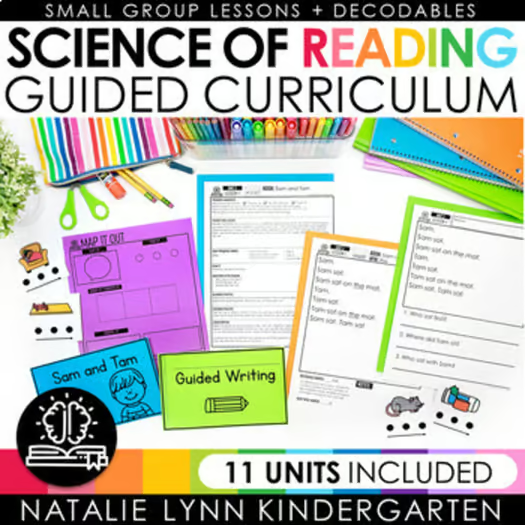
The Science of Reading Guided Curriculum is an affordable print-and-go curriculum that teaches all the phonograms in an incremental and systematic way while providing an abundance of review. It covers decoding, word building, vocabulary, and reading comprehension. I especially appreciate the bite-size lessons. And it comes with 211 decodables!
For a detailed list of resources and teaching techniques, see the following posts:
Teaching Children with Down Syndrome to Read: A Parent’s Step-by-Step Guide

Teaching Children with Down Syndrome how to Sound Out Words
Teaching Children with Down Syndrome to Read: Our Top Ten Resources for Beginning Phonics
Favorite Publishers of Emergent Readers
To see all my phonics resources, see this page: Teaching Children with Down Syndrome to Read: Phonics
In our Down Syndrome co-op, I see a wide variety of reading progress. It is important to remember that each child and family circumstance is unique. With intensive teaching, some children with DS learn to read at an early age. At the same time, others do not progress in reading until later:
Not all children with Down syndrome are going to be able to make an early start with reading. Many ordinary children are not able to begin to learn to read in their pre-school years, the range in normal reading development is wide with some children starting in their pre-school years and others not until they are eight or nine. We would expect the same range in children with Down syndrome. Children who start later may make rapid progress and become good readers. We know teenagers who are now reading for pleasure but did not show any interest in reading until they were eight or nine years old.
— Buckley, S, and Bird, G. (1993) Teaching children with Down syndrome to read. Down Syndrome Research and Practice, 1(1), 34-39. doi:10.3104/perspectives.9
The main thing is to try and try again, to try different approaches, and if these fail, wait a bit and try some more. A curriculum that failed to work for your child may be very effective a few months or even a year or two later.
Spelling
Word building is an essential part of any phonics program because it deepens children’s understanding of how phonics works. Word building also helps children orthographically map newly learned words so as to recognize them at sight. And, it prepares students for spelling.
Thus, as children are learning to decode words, they should also practice building those words. First Steps with Phonics includes different word building activities designed for children with Down Syndrome that gradually lead to spelling.
For first grade spelling, we used All About Spelling Level 1 with several adaptations. My son really enjoyed the different activities.

For suggestions and videos on how to adapt All About Spelling, see my post on Teaching Spelling to Children with Down Syndrome .
You can find all my adapted spelling worksheets in my Spelling Resources for Children with Down Syndrome page.
Handwriting
When your child is working on spelling or copying a sentence from dictation, don’t expect neat handwriting. So much effort and concentration is going into segmenting and remembering and choosing the right letters/phonograms that it is difficult for many students to concentrate on neat handwriting as well.
At the first grade level, most students (with or without Down Syndrome) will need to work on handwriting as a separate subject in order to improve their handwriting skills.
For first grade, two handwriting programs I recommend, (and we have used both) are Letters and Numbers for Me from Learning Without Tears and Handwriting Skills Kindergarten Megabundle of Fun by Print Path OT. Most students with Down Syndrome will need much more practice than what is in the workbooks. Because Print Path is a digital download, you can print out and repeat sheets as often as needed.

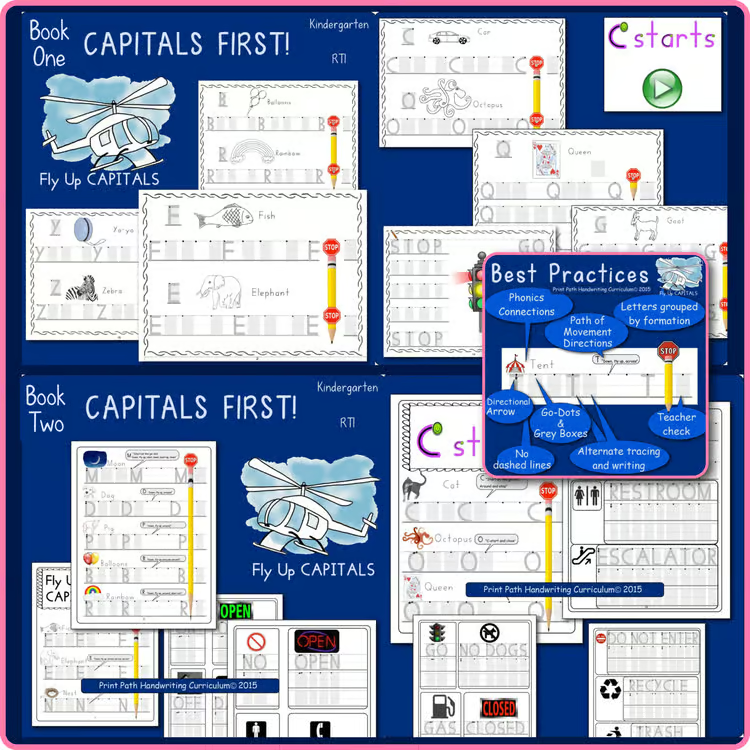
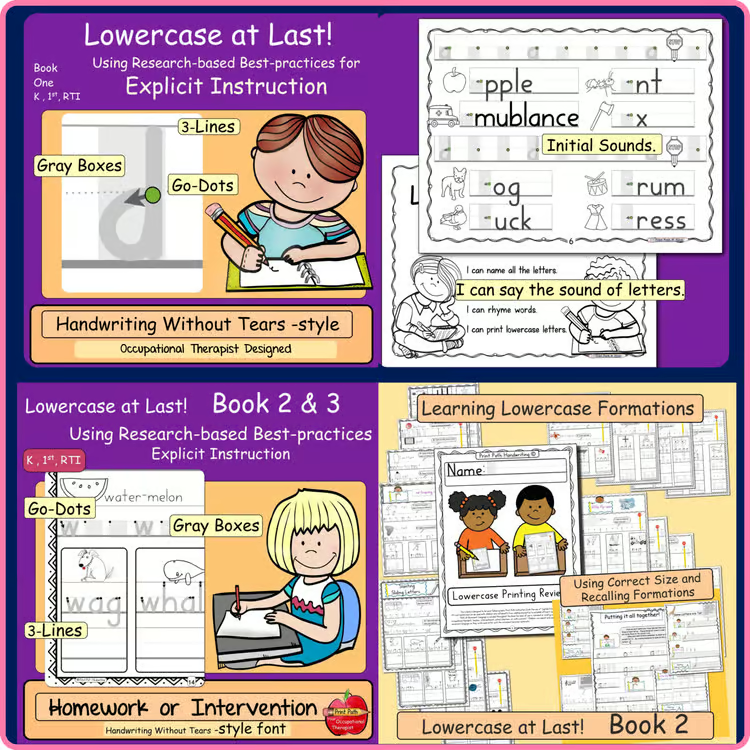
If your student is not ready for these, see my Handwriting Resources for Children with Down Syndrome. I have created many sets of worksheet for children who are not ready for the small fonts in Learning Without Tears and Print Path OT.
For example:


Uppercase Block Letters – FREE!
To keep your student motivated, always encourage any effort. Instead of getting on your child’s case about imperfect letters, give lots of praise for letters that are well done.
Be sure to check out my list of Favorite Handwriting Tools for kids with Down Syndrome.
And stay tuned for this post: Handwriting Skills for Children with Down Syndrome coming up soon!
Creative Writing and Journaling
Spelling and handwriting become meaningful in the context of creative writing. It think it is important for our children with DS to understand that spelling and handwriting are useful because they are tools for communication.
Creative writing and Journaling is an opportunity for our children to talk about the things that are important to them and have them put down in writing. The goals at this stage are to foster a love for creative writing and to help children create a written record of their lives and what interests them. So, we keep the tone conversational and easy-going.
Here are some creative writing exercises we do that you might find useful:
- My son dictates a story and I write it down for him. Then, he reads it out loud.
- My son makes up a sentence about a book we read. I write it down and cut it into pieces. He reassembles the sentence and pastes it in a book.
- My son dictates a letter to a family member. I write it down and he copies it.

For his journal, my son dictates a few sentences about what he did or learned that day. I write it down, and he copies one sentence. We also talk and write about:
- favorite foods, favorite animals, favorite toys, etc.
- the weather
- special events and holidays
- family and friends
- things he likes or doesn’t like
- favorite characters, stories, shows
- what he learned in science, geography, or religion
Adding a picture to the “composition” makes the entries in the journal or notebook more memorable.

Some grammatical points you can gently encourage are capitalization at the beginning of sentences and using the correct ending mark at the end of each sentence.
Sentence Building with Surprise Envelopes
One fun activity I found in the online book Down Syndrome: Reading and Writing is the use of Surprise Envelopes. My son really enjoys these. I write a short high-interest sentence on a strip of paper and then cut up the strip so there is one word on each piece. I put the pieces into an envelope. As he pulls out each word, and read it. Then, he arranges the words in order to make a sentence.
Poetry
All of my children have memorized and recited poetry as part of their homeschooling because doing so not only trains the memory, it also fills the mind with beautiful imagery and words.
For my son with Down Syndrome, memorizing and reciting poetry allows us to work on articulation, elongating the vowels to slow down his speech, and reciting with expression.
Each week at co-op, the children are given an opportunity to recite a poem or sing a song. The extraverted boisterous kids love the attention and applause, and the shy, soft spoken ones become accustomed to standing in front of an audience and performing.
Here’s a compilation of poems I made for my son and his buddies and some sample pages:


Math
For many children with Down Syndrome, while reading is a relative strength, math remains elusive even after years of working on math skills. According to a study of 90 individuals with Down Syndrome ages 11 – 17, only 18% could count beyond 20 and only about 50% could solve simple addition problems.
Nonetheless, there is a broad range of mathematical achievement among individuals with Down syndrome, and some students have been able to progress as far as studying algebra. We will not know how far each of our students can progress in math unless we as teachers/parents give a persevering and concerted effort — trying different curricula and methods, giving our students concrete and visual supports, giving our students consistent and daily practice and encouragement, and then, if it seems a student has hit a wall, pausing for a few weeks and then trying again.
Regardless of what our children with DS are able to achieve in math, it is still a subject worth pursing, not only for its functionality but also to help our students see the beauty, order, and harmony inherent in our cosmos. To that end, it’s good to remember that there is so much more to math than making calculations. Geometry, measurement, time, charting and graphing — all of these are important parts of math that help our students observe the world around them while training and exercising the mind.
Here are my favorite math curricula, manipulatives, and resources for first grade math:

For sample pages of the workbook, click here.
The teacher’s manual is clear and succinct and full of hands-on activities that illustrate the concepts in a meaningful way. It also incorporates continuous review of previously learned material, so it’s important to use both the TM and the workbook. The workbook uses a large font and the pages are colorful and uncluttered. Students use one-row ten frames to help them solve addition and subtraction problems. This helps them learn to subsitize numbers (recognize quantities without counting), which in turn helps in the development of number sense.
As the book progresses, students are encouraged to use mental math strategies to solve addition and subtraction. For our students with T21, I recommend allowing them to use one-row ten-frames or a rekenrek for as long as they need. Because of challenges with short-term memory, it can be very difficult for our kids to hold and manipulate numbers in their head. Manipulatives and pictures are important supports that help our students understand mathematical concepts.
I also recommend getting two copies of the student workbook so you can model how to do the activities in one book and encourage your student to do his/her own workbook as independently as possible.
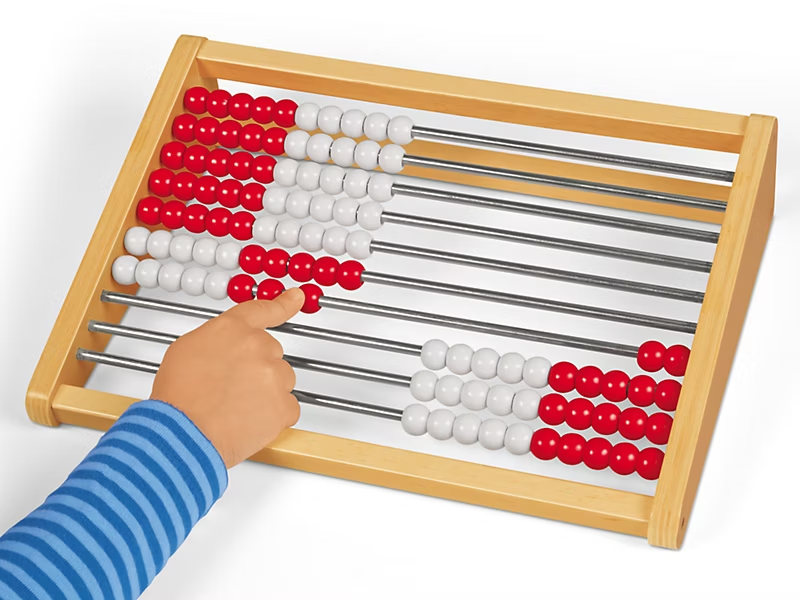
Similar to a one-row ten frame, a rekenrek is a fantastic tool for developing number sense as it helps students to see numbers in relation to other numbers (ie. 4 is one less than five, 7 is five and two, etc.) We use a 20-bead rekenrek to support addition, subtraction, building of numbers, and comparison of numbers. It is more efficient than a ten-frame because counters don’t get lost, and my son can quickly subsitize and slide quantities without having to count. Kate Snow, author of Math with Confidence writes that her no. 1 math manipulative is an AL abacus (right), which is similar to a rekenrek (left).


I prefer the rekenrek because the larger beads on the rekenrek make it easier to use for children with fine motor challenges.
Once students start working with numbers above 20, we use a 100-bead rekenrek. I particularly like this one from Lakeshore Learning.
Montessori Wooden Number Cards
These are a great aid in helping students understand place value.

We often use these along with 100-bead rekenreks to build and compare numbers.
Simply Addition and Simply Subtraction
If your child is really struggling with the math facts, see this post: Ten Essential Math Skills that Prepare Children with Down Syndrome for Addition and Subtraction
Many children with Down Syndrome will need much more practice and review than what is available in math curricula designed for typically developing children. If your student needs more practice with addition and subtraction than what is in Math with Confidence, or if you just want to focus on Addition and Subtraction for a time, consider these resources:

Simply Addition Level 1 Workbook: Addition within Ten (FREE on this blog with teacher’s guide included)


Simply Subtraction Level 1 Workbook (teacher’s guide included)


This series gives students abundant review and makes math both visual and tactile with the use of a rekenrek.
You can find all my math resources at this page: Math Resources for Children with Down Syndrome
The very best math resources: Fun and Joy
Finally, I’d like to share this wonderful passage from Andre Frank Impel, Professor for Learning and Development at the University of Hamburg, Germany. He studied nearly 1,300 people with T21 and wrote a fascinating book, Trisomy 21: What we can learn from people with Down Syndrome.
Emotions, no matter whether positive or negative, are obviously more intense and long-lasting in people with trisomy 21. Didactically, greater responsibility derives from it: Frustrations due to failure in learning can develop undesirably long and sustainable effects.
Once aroused, aversions to a subject sometimes build up so much that they can cause learning difficulties. For example: Two boys with trisomy 21 in an integration class responded to the words “mathematics” and “arithmetic” with vigorous opposition. In protest, they wanted to leave the room immediately. It cost the teacher an incredible amount of energy to prevent this….
We not only remember what we have learned, but also how we then felt — when the feeling are mostly negative, we don’t like to remember. Hating to remember what we have learned, is an expression of wasted lifetime, in other words bulimic learning.
Emotions that are stimulated when learning should therefore be directly related to a subject matter experienced as meaningful and should not distract from it. For example: When you’re done with the arithmetic exercise, we’ll go to the movies! Arithmetic then becomes a chore. It’s better to demonstrate one’s own joy in arithmetic, this increasing the likelihood of the emotional spark spilling over.
If we are to succeed in teaching our children with Down Syndrome math, we must first succeed in making it enjoyable. I constantly remind myself it is better to do less math, even less efficiently, but with fun and laughter, than to muscle our kids into doing more math but with gritted teeth and complaining.
For my son with Down Syndrome, playing math games has been very motivating. Also, incorporating pretend play into our math lessons has been a game changer. We have a stash of Duplo figures who take turns solving math problems. I make these toy people bicker over whose turn it is, ask my son for help, make mistakes, sing and chant math facts, and cheer my son on. He also role plays the figures, which is so good for his speech. It makes math a whole lot more fun for the both of us.
Science
To observe the beauty of God’s creation and to marvel at it — this is my goal for science. Because of this, nature study is my favorite approach to science in the early years. Thankfully, our co-op has a nature study class that my son attends.
In addition, here are some of the science books and resources we have really enjoyed:

Discovering God’s World – This science reader by Abeka has lots of big, bright pictures and just the right amount of text. It includes easy activities/experiments you can do at home as well as comprehension questions.

The Explore Life Cycle Series by Mary R. Dunn contain six books:
- An Apple Tree’s Life Cycle
- A Bean’s Life Cycle
- A Butterfly’s Life cycle
- A Frog’s Life Cycle
- A Sunflower’s Life Cycle
- A Turtle’s Life Cycle
These books feature beautiful photographs, extra-large font, and simple text.

There are many Montessori life cycle trays you can purchase to supplement these books. We used one similar to this.
The Science Adapted Readers Pack for Special Education by Twinkl are easy to read and great for building science-based vocabulary. They cover these topics:
- Butterfly life cycle
- Hibernation
- Hot and Cold
- Insects
- Living and non-living
- Our Solar System
- Parts of a Plant
- The Ocean
- The Rain Forest
We have used some of them them in our co-op, and the boys have done really well with them.
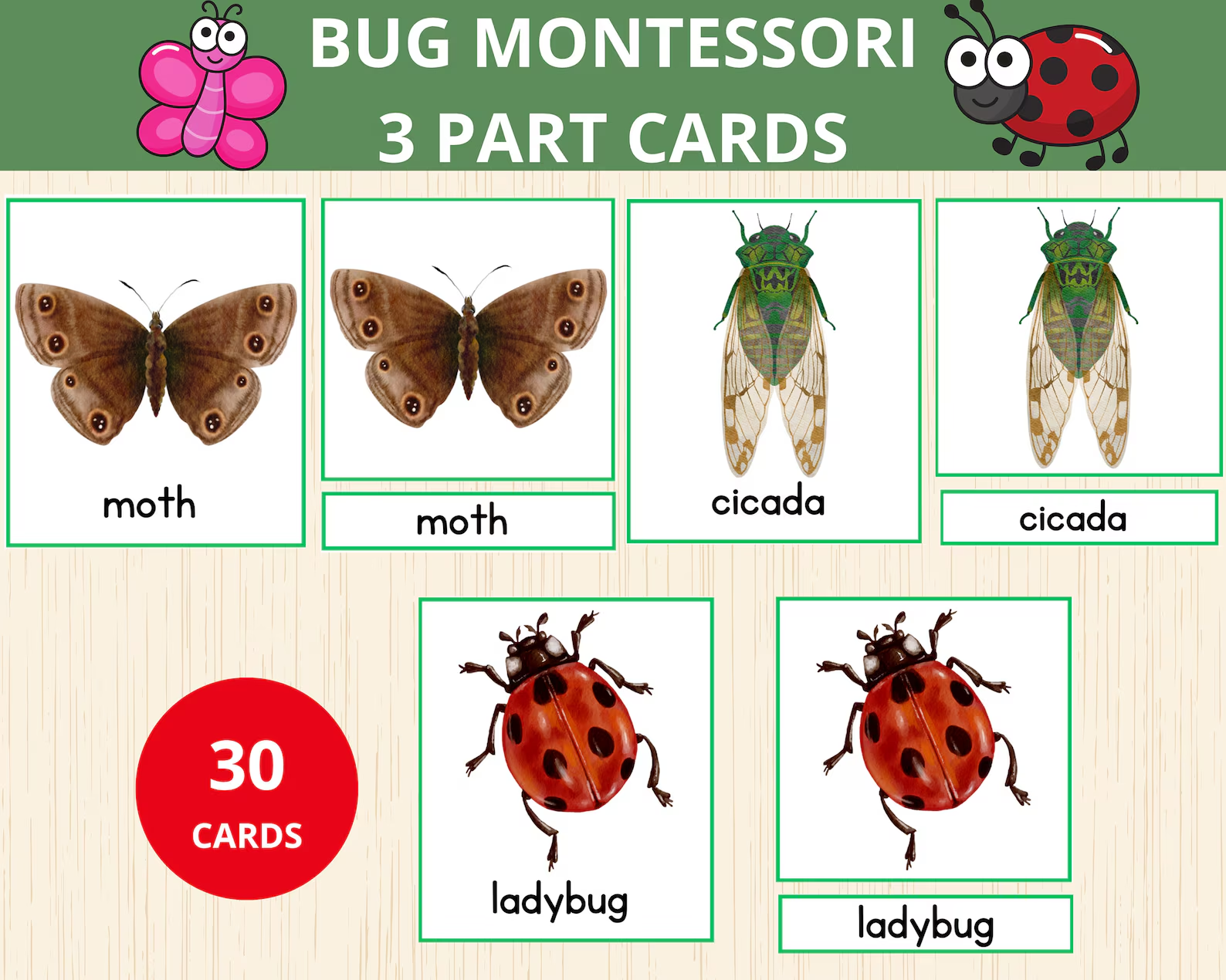
Finally, Montessori Three-Part Cards help children learn the names of different insects, birds, and flowers. We have enjoyed these cards from Etsy:


Geography
We began our study of Geography with this cute little book:

TeachersPayTeachers has many activities where students can make their own version of “Me on the Map”.
Next, we slowly read through:

This book has big, colorful pictures with lots of interesting facts about each of the continents.

This Lift and Learn Continents Puzzle was a fun activity that helped my son learn the names and shapes of the continents.
Art and Music
Looking at beautiful artwork is a wonderful springboard for conversation, which in turn makes for a great journal entry.

Art Masterpieces: Childhood Collection, by Catholic Heritage Curricula – This features 16 art masterpieces and comes with a simple but helpful teacher’s manual. Students also are given the opportunity to find paintings that are similar in style.

Discover Great Paintings – This over-sized gem of an art book is out of print, but worth buying used. All of Lucy Mickelthwaite’s art books are wonderful. This one is my favorite because students are guided to look more closely at details in each painting and the author shares interesting tidbits about the artwork.
Kumon my First Book of Drawing – gives step by step instructions for drawing very simple pictures.
Cutting Strips from Little Spark Co. – At the beginning of the school year, my son could not use scissors. Several days a week we practiced cutting these attractive seasonal/thematic cutting strips. Now he can cut a straight line independently! We have since moved onto Kumon’s Let’s Cut Paper.


Classical Kids series on Spotify (or buy the CDs on Amazon)- all of my children have enjoyed these audio dramas about the lives of famous composers. My son with DS has listened to Beethoven Lives Upstairs and Vivaldi’s Ring of Mystery so much that he has them memorized! He has also enjoyed Mozart’s Magnificent Voyage, and Mr. Bach Comes to Call. I have NOT let him listen to Hallelujah Handel (yet) because it is about a young boy who was enslaved and was so traumatized he could not speak.

If your child is interested, teach him/her to play simple tunes on the xylophone by imitating you. It’s so good for memory and sequencing skills.
What I like about this xylophone is that the keys are removable, so you can give your child only the ones they need when they are learning a new song. For example, for “Hot Cross Buns”, they only need the red, yellow, and orange keys.
And the Best for the last: Religion
Catechesis of the Good Shepherd Program – This is a Montessori-based, hands on religion program for children. We are blessed to have one as part of our co-op, and the kids are learning so much! If you are able to find such a program at a nearby parish, I highly recommend it. See this post: Catechesis of the Good Shepherd for Children with Down Syndrome.
In addition, I have created these resources for my son:
Mysteries of the Rosary 3 part Cards
Articles of the Mass 3 part Cards
You can find all my religion printables at the this page: Religion Resources for Children with Down Syndrome
For an easy-reader bible with lots of pictures, we like A Child’s First Bible by Kenneth Taylor. After each two page spread, there is a question to help your child remember what was just read.

My son LOVES to read the comic-style Illustrated Gospel for Children.

The font is a little too small for him, but he’s determined to read it anyway!
So these are all my favorite first grade curricula for children with Down Syndrome! I hope some of these resources will be helpful for you and your student.
For kindergarten curricula, see this post: A Kindergarten Curriculum for Children with Down Syndrome.


